Published February 19, 2026 Updated February 19, 2026
Document the Why, Not the How (For AI Coding Agents)
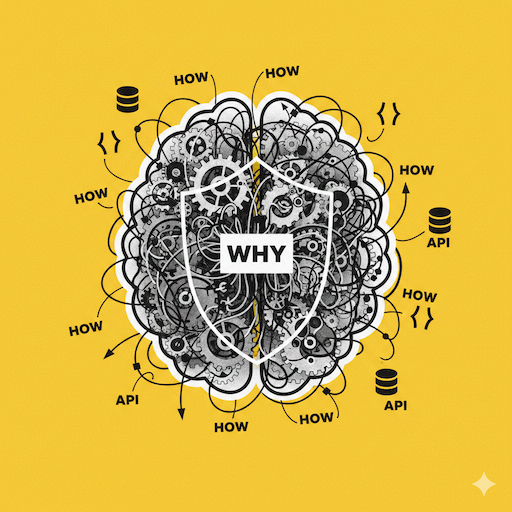
When people talk about "documentation for AI," they usually mean explaining the codebase so the agent can understand it.
Folder structure overviews.
Architecture summaries.
Long explanations of how routing works.
That made sense at first. We assumed AI needed hand-holding.
But modern coding agents like OpenAI Codex and Claude Code are already very good at reading your code directly. They follow imports, infer framework conventions, detect patterns, and reconstruct architecture from usage. In many cases, they understand your implementation faster than a new human contributor would.
So the real question is uncomfortable:
If the agent can already understand the how, what exactly are we documenting for?
The Over-Documentation Trap
Early-stage builders often react to AI tools by over-explaining everything:
- Detailed architecture walkthroughs
- Step-by-step explanations of obvious framework patterns
- Descriptions of files whose purpose is self-evident
- Notes about decisions that are still changing weekly
It feels disciplined. It feels responsible.
But in fast-moving products, this kind of documentation ages quickly. Worse, it can mislead. If your explanatory document says one thing and the code has already evolved, the AI agent may treat the document as authoritative. Now you have created a second system that must be maintained in parallel with the code.
That is unnecessary friction.
Implementation details change. AI can read them anyway.
The real scarcity is not structural clarity. It is decision clarity.
What AI Cannot Infer
An AI agent can infer:
- How your billing module works
- How your redirect logic is structured
- Where validation happens
- Which framework conventions you follow
It cannot infer:
- Why you rejected subscriptions
- Why you intentionally limited analytics
- Why certain features are deliberately excluded
- Which trade-offs define your product identity
Those decisions are invisible in code. And they are exactly the decisions that prevent drift.
If you never write them down, the agent will default to common industry patterns. Technically correct. Strategically misaligned.
That is where erosion begins — quietly.
Shift the Focus
Instead of explaining your implementation to the AI, document the constraints that guide it.
For example:
- Pricing philosophy
- Ownership model
- Non-negotiable product principles
- Explicit "we will not build this" boundaries
- Trade-offs already accepted
These do not change every week. And when they do change, that change is meaningful.
A short, focused document capturing these points gives your AI agent something far more valuable than an architecture essay. It provides intent.
Then, when you prompt:
Improve monetization logic.
You might remember to add:
Preserve one-time payment. No subscriptions. No scan caps.
But what happens when you forget?
When the constraint only lives in your prompt, it disappears the moment you don't type it.
The agent doesn't drift because it's wrong.
It drifts because you were busy.
Keep It Lean and Alive
You do not need a heavy documentation system. One evolving file is enough. Something like:
/docs/product-principles.md
Inside, capture:
- Core values driving the product
- Why certain monetization models were rejected
- Known constraints that future features must respect
- Historical decisions and their reasoning
Write in plain language. No slogans. No marketing voice. Just clear thinking.
If the file grows too large, ask your coding agent to split it into smaller thematic documents. They are excellent at restructuring content while preserving meaning.
Implementation Is Fluid. Intent Should Not Drift.
In the AI era, rewriting a module is cheap. Migrating frameworks is cheaper than ever. Even major refactors can happen in days.
That makes philosophical drift more dangerous.
If your reasoning is not written down, small optimizations accumulate. A minor feature addition here. A monetization tweak there. Each one logical in isolation. Together, they can move the product somewhere you never consciously chose.
Documenting the why does not slow you down. It stabilizes direction while you move quickly.
Let the AI read your code.
You focus on writing down what the code is not allowed to forget.